 DashFox
Don't judge it by the dollar amount alone. Judge it by time, miles and costs. In our examples, $4.25 for 30 minutes and 6.5 miles is $8.50 an hour gross. $4 for 10 minutes and 1.2 miles is $24 an hour gross. Neither is a take-home or whole-shift rate.
DoorDash lists no minimum acceptance rate, but declining can affect your Rewards eligibility. [2] Check that trade-off as well as the offer's numbers.
Two $4 offers, two different answers
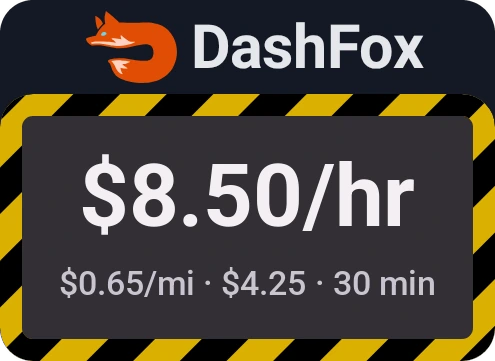
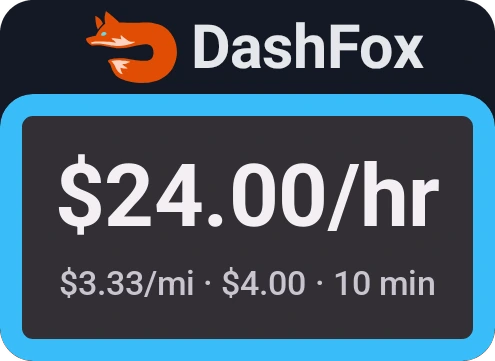
Two made-up offers as DashFox would show them. Example data.
Almost the same pay. One is $8.50 an hour, the other $24. The difference is the clock and the odometer, which is why DashFox puts both on the bubble.
The car-cost test: use your own budget
Fuel is only part of vehicle cost. Allow for maintenance, tires, insurance and depreciation too. One published reference is the IRS business standard mileage rate: 76 cents a mile for July–December 2026, based on a study of fixed and variable vehicle costs. [3] [4]
That is an optional tax-deduction rate, not a measurement of what your car costs. It does not prove that a particular offer loses money. To see the effect of costs, suppose you choose a hypothetical vehicle budget of 76¢ a mile:
$4.25 for 6.5 miles
At that assumed budget: 6.5 × $0.76 = $4.94. The $4.25 payout is $0.69 below it, before accounting for your time.
$4.00 for 1.2 miles
At the same assumed budget: 1.2 × $0.76 ≈ $0.91. About $3.09 remains before taxes and other expenses.
Replace that assumption with a budget based on your own vehicle records. Count any extra drive back as well. A tax deduction reduces taxable income; it isn't a reimbursement or a guaranteed profit margin.

Set two personal checks: does the offer cover your vehicle budget for the full trip, and is the remaining pay worth the time? Our offer calculator shows the gross $/hour and $/mile; it does not subtract expenses.
Why low offers exist
DoorDash describes pay as base pay, tips and applicable promotions. In Earn per Offer, its published base-pay range is $2–$10+, depending on estimated time, distance and desirability. The acceptance screen shows a guaranteed minimum; final earnings can be higher. [1] Judge the shown amount rather than counting on extra pay that hasn't appeared.
A low total doesn't reveal the exact tip breakdown. DoorDash says some merchant-placed orders don't offer the customer a tipping option, so a small payout isn't proof that someone deliberately refused to tip. [1]
DoorDash lists desirability among its base-pay factors, including how other Dashers have seen the offer. [1] That doesn't promise a particular increase after a decline, or that the offer will come back to you. Judge the amount shown now.
When a small offer can make sense
- It's short and close. A quick pickup and a short drop can pay a fine hourly rate even at $4, like the second offer above.
- It's on your way. Consider the extra detour, pickup wait and handoff time—not just whether the destination is near home. A delivery can add work even when some of the route overlaps your own trip.
- It's part of a stack. Judge the complete offer: total pay ÷ total minutes × 60 for the hourly projection, and total pay ÷ total miles.
- You're protecting a Rewards level. That's a real trade-off; our acceptance rate guide walks through it.
Declining affects acceptance rate, while accepting and then unassigning can affect completion rate. DoorDash lists a 90% completion minimum and exceptions such as an app-marked worry-free unassign. [2] Don't accept first just to decide later.
Quick questions
Why are some DoorDash offers so low?
DoorDash's pay model includes base pay, tips and applicable promotions. A small guaranteed minimum is a small offer—not a promise that an additional tip will appear. Some merchant-placed orders do not give customers a tipping option. [1]
Does declining low offers hurt my account?
DoorDash lists no minimum acceptance rate, but declines can affect your Rewards level. Completion rate is separate: unassigning after acceptance can affect that rating unless an exception applies. [2]
What's the lowest offer I should accept?
There's no single payout that works for every route. Compare estimated total time, full-trip miles, your vehicle budget and any Rewards trade-off. The IRS mileage rate is a tax calculation reference, not your personal break-even figure. [3] [4]
Is $1 a mile enough?
Not necessarily. A $1-per-mile offer says nothing about how long it takes, your actual vehicle costs or an unpaid return trip. Being above the IRS tax rate does not establish profitability. Our dollars-per-mile guide explains why the clock matters too.
Keep reading
 On the job
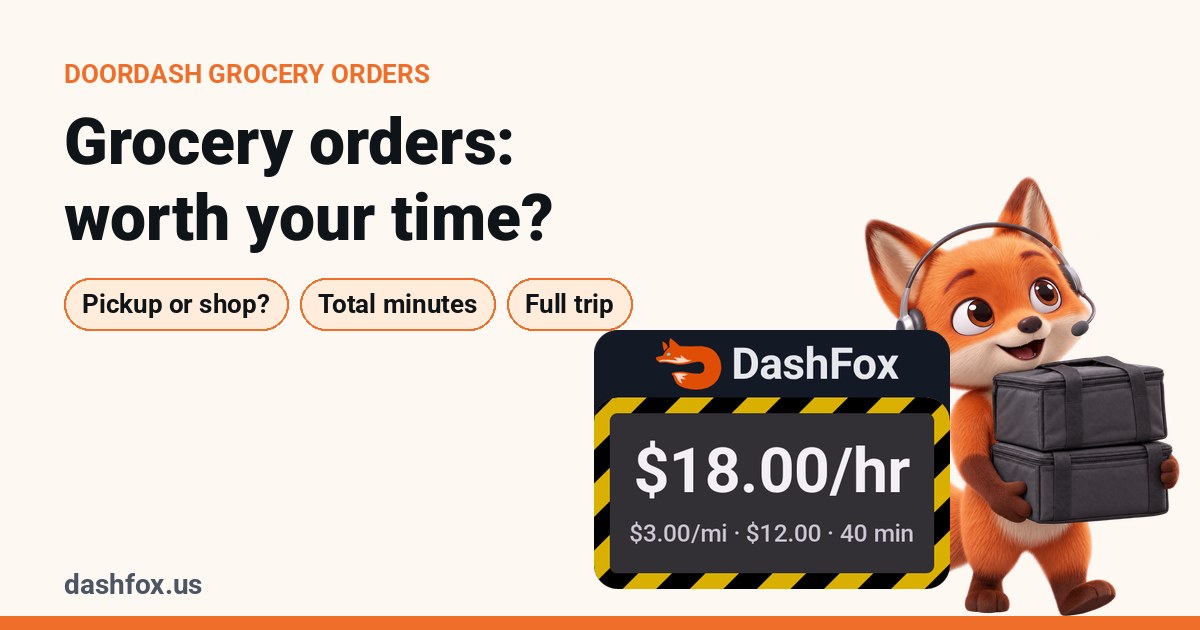
Are DoorDash grocery orders worth it?
A bigger payout isn't automatically a better hourly rate. Check the task and the full trip.
 Offer math
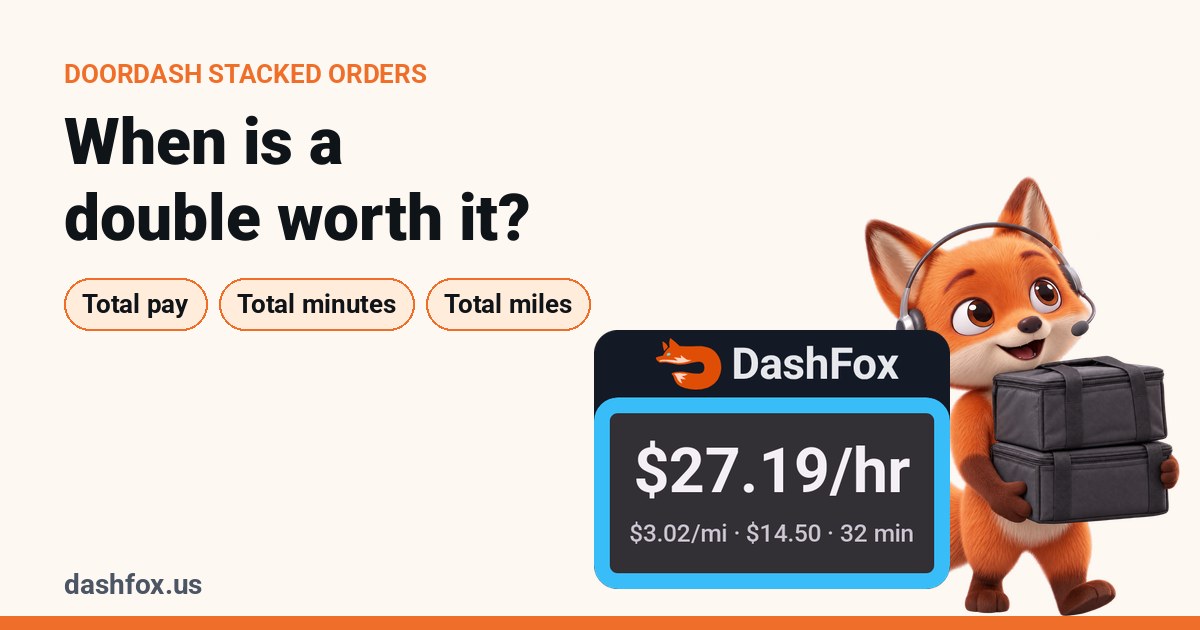
DoorDash stacked orders: when is a double worth it?
A small order inside a batch needs the full-route comparison. Add-ons need a separate check of extra time and miles.
 Offer math
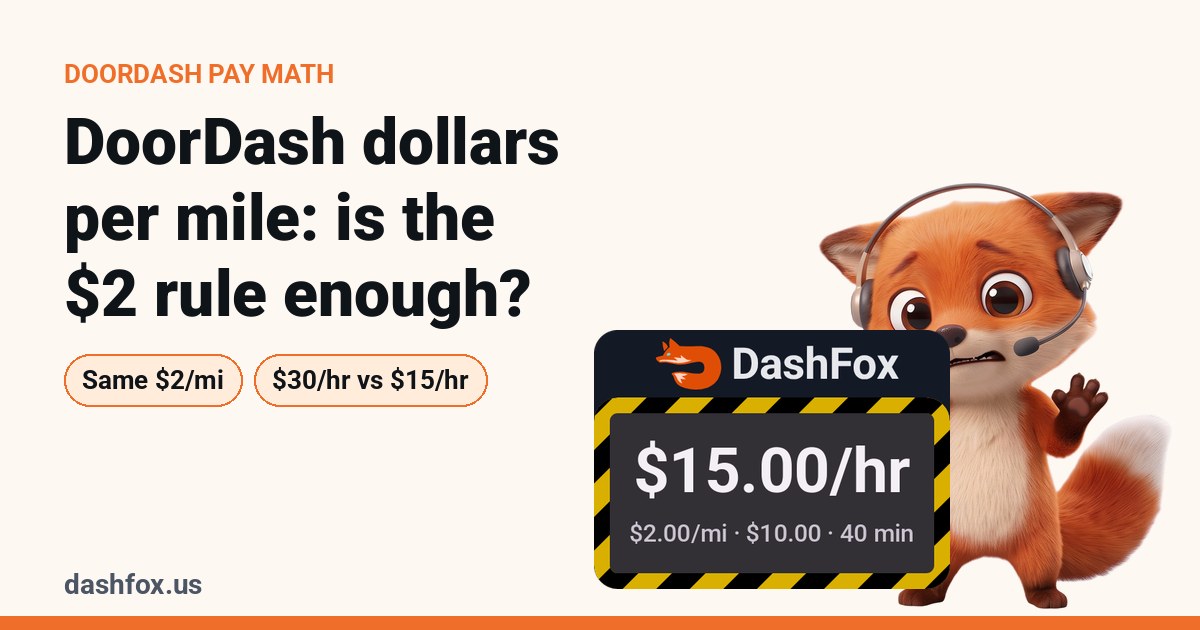
DoorDash dollars per mile: is the $2 rule enough?
Same $2 a mile, $30 an hour vs $15 an hour.
 Free tool
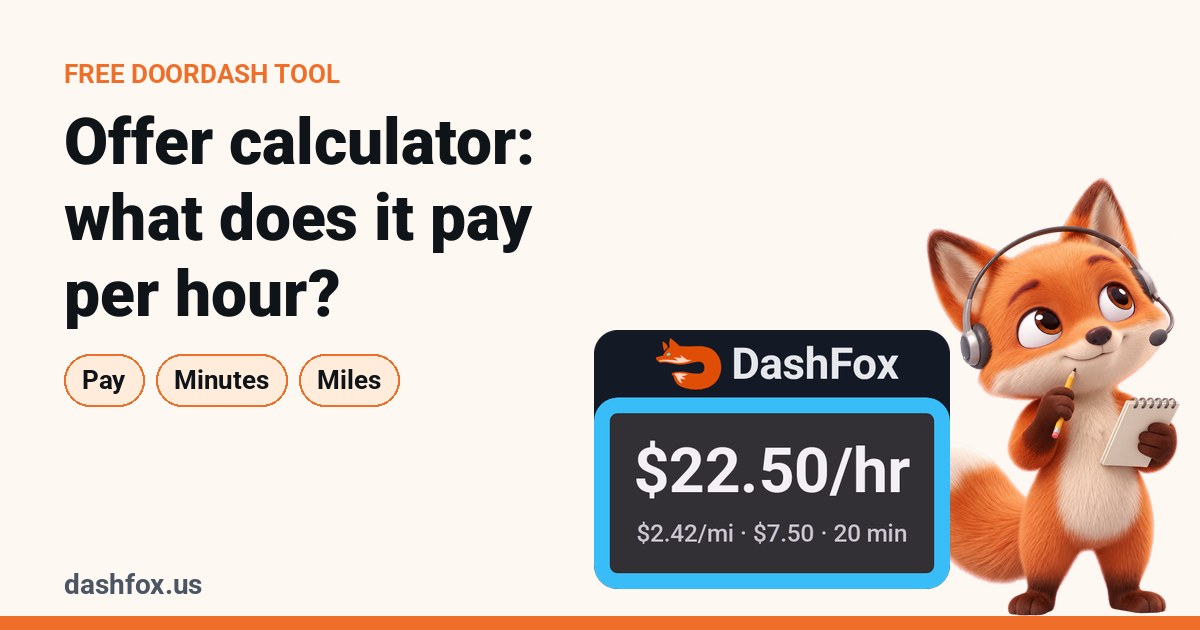
DoorDash offer calculator
Pay, minutes and miles in; $/hour and $/mile out.
Sources
- DoorDash Help: How Dasher Pay Works. Base-pay range and factors, tips, promotions, guaranteed minimums and merchant orders without a tip option. Checked October 30, 2026.
- DoorDash Help: Dasher Ratings Explained. Acceptance rate, Rewards eligibility, completion-rate minimum and worry-free exceptions. Checked October 30, 2026.
- IRS: Standard mileage rates. Business rate 76¢/mile for July 1–December 31, 2026; 72.5¢ for January 1–June 30. These are deduction rates, not a driver's measured expenses. Checked October 30, 2026.
- IRS: 2026 business standard mileage rate (IR-2025-128). Optional deduction method, fixed/variable-cost study and the alternative of actual expenses. Checked October 30, 2026.
Both offers and the vehicle-budget comparison are constructed examples, not typical earnings. Hourly figures are gross offer-level projections, not take-home pay. The IRS rate is not a reimbursement or a measurement of your vehicle costs; this is not personal tax advice.