 DashFox
Offer math
DoorDash dollars per mile: is the $2 rule enough?
Dividing pay by miles is a great habit. But two offers with the exact same dollars per mile can pay very different money for your time. Here's how to spot the difference.
A $2-a-mile rule is a starting filter, not proof that an offer covers your costs.
It can't tell you what the offer pays for your time. Two offers can both pay $2.00 a mile and work out to $30 an hour vs $15 an hour. So check $/mile, then check $/hour.
Is $1 per mile good for DoorDash?
Not automatically. A dollar per mile is gross offer pay, not profit or a universal minimum. Whether it's worth taking depends on your vehicle costs, total trip time and any unpaid drive back.
Example data: a $10 offer for 10 miles is $1 per mile. If the trip takes 20 minutes, that works out to $30/hr gross; at 50 minutes, $12/hr. Neither rate subtracts gas, wear or taxes, and neither guarantees your earnings over a whole shift.
Same $2 a mile, half the pay for your time
Two offers, both $10 for 5 miles. Both pass the $2 rule with flying colors.
The difference is the clock. The first is due in 20 minutes. The second is due in 40, maybe because of a longer route or a busy part of town.
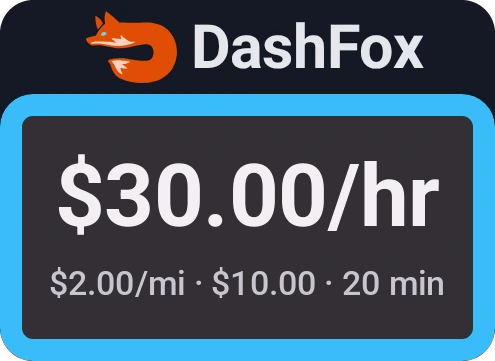
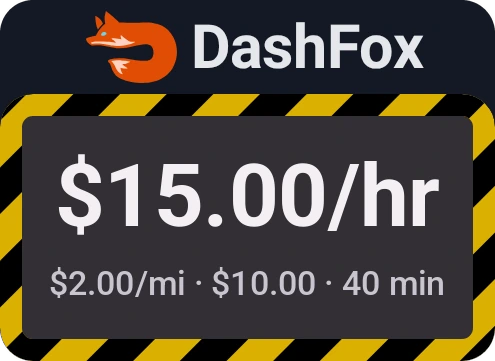
Both pay $2.00 a mile. One pays $30 an hour, the other $15. Example data.
The faster order pays you twice as much for every hour you spend on it. Your $2 rule can't see that, because it never looks at the clock.
Per mile pays your car. Per hour pays your time.
Dollars per mile
What the order pays your car: gas, wear, all those miles.
Dollars per hour
What the order pays your time: the one thing you can't get more of on a shift.
You want both to look good. A great per-mile offer that eats most of an hour is a poor use of a busy dinner rush. A great per-hour offer that drags you across town is hard on your car.
DoorDash's offer screen shows the guaranteed pay, the distance and a "deliver by" time. [1] Base pay is set from estimated time, distance and how desirable the order is, not a flat rate per mile. [2] That's why the per-mile figure jumps around so much from offer to offer.
Both checks are one quick sum. For dollars per mile, divide the pay by the miles:
For dollars per hour, count the minutes to the deliver-by time, divide, then multiply by 60:
Want to do the hourly part in your head in a couple of seconds? Our guide to what a DoorDash offer pays per hour has a cheat sheet for it.
More offers where the $2 rule trips you up
Say you see two offers on the same night. One pays $10 for 4 miles, due in 40 minutes. That's $2.50 a mile, an easy yes under the $2 rule.
The other pays $15 for 10 miles, due in 30 minutes. Only $1.50 a mile, so the rule says skip it. Now look at the clock. Thirty minutes is half an hour, so double the pay:
The "good" $2.50-a-mile offer pays just $15 an hour. The one your rule would skip pays twice that for your time.
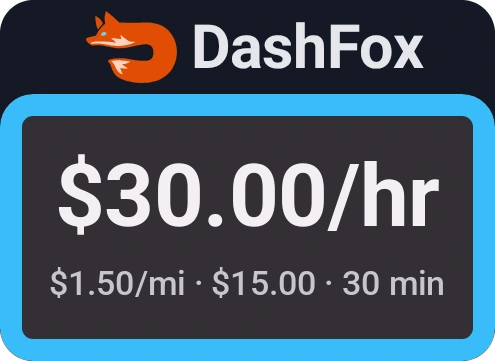
That doesn't make the $15 offer an automatic yes. It's 10 miles of gas and wear, and you'd want to know where it ends. And skipping one offer never guarantees a better one comes along. But a miles-only rule would have hidden the trade-off from you completely.
A $12 offer pops up: 6 miles, due in 25 minutes. That's $2.00 a mile and $28.80 an hour. Looks great.
But the drop-off is out on the edge of town. Getting back to where the orders are takes another 4 miles and 15 minutes, unpaid. Count those, and the same $12 now covers 10 miles and 40 minutes:
Same offer. It just stopped clearing the $2 bar.
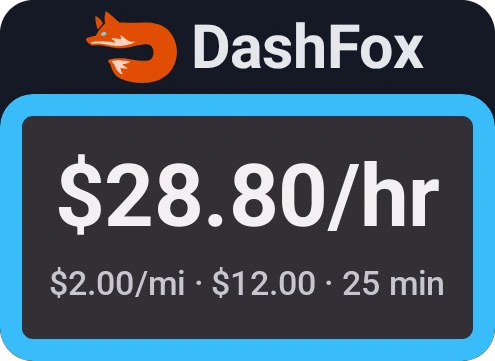
Plenty of orders end right where you want to be. Just glance at where this one ends before you tap Accept.
This one came from a dash we recorded ourselves: $9.00 for 2.5 miles. That's $3.60 a mile, nearly double the $2 rule, and it looks like an easy yes.
The order would have taken about half an hour, so all those dollars per mile came out to less than $19 an hour. We declined it. Miles look great on paper; the clock is what pays the bills.
A quick offer check: miles, minutes, then the map
- Miles. Pay ÷ miles. Does it clear the minimum that makes sense for your car?
- Minutes. Pay ÷ minutes × 60. Is it worth your time?
- What the numbers miss. Where does it end? Is the restaurant one you know runs slow? Any tolls or a long drive back?

Safety first: don't do math or handle your phone while you're driving. If an offer pops up on the road, pull over somewhere safe or let it go.
What DashFox does (and doesn't) see
DashFox handles steps 1 and 2: it shows $/hour and $/mile the second an offer pops up, so you can take it or skip it before the timer runs out.
Step 3 is still yours. The hourly figure uses the timing on the offer screen, so it doesn't predict a slow restaurant or add your drive back. And neither rate subtracts gas, wear or taxes. You know your town; DashFox just gets the sums out of your way.
Quick questions
Is $2 per mile always worth it?
No. In the examples above, two $2-a-mile offers paid $30 and $15 an hour, and a $2-a-mile offer fell to $1.20 a mile once the drive back was counted. $2 a mile is a good start; then check the minutes and where the order ends.
Is DashFox's $/hr the same as Earn by Time?
No. Earn by Time is a DoorDash pay mode: DoorDash pays a guaranteed rate for your active time, from accepting an offer until you complete it. [2] DashFox's $/hr is arithmetic on an offer's pay and timing, there to help you decide. It isn't a guarantee of what you'll earn.
Keep reading
 Vehicle costs
Is DoorDash worth it after gas?
Count car costs, unpaid return miles and all the time—not just fuel.
 Tax-season preparation
The 2026 mileage deduction
The IRS rate is a tax method—not your measured vehicle cost or an offer-acceptance floor.
 Offer math
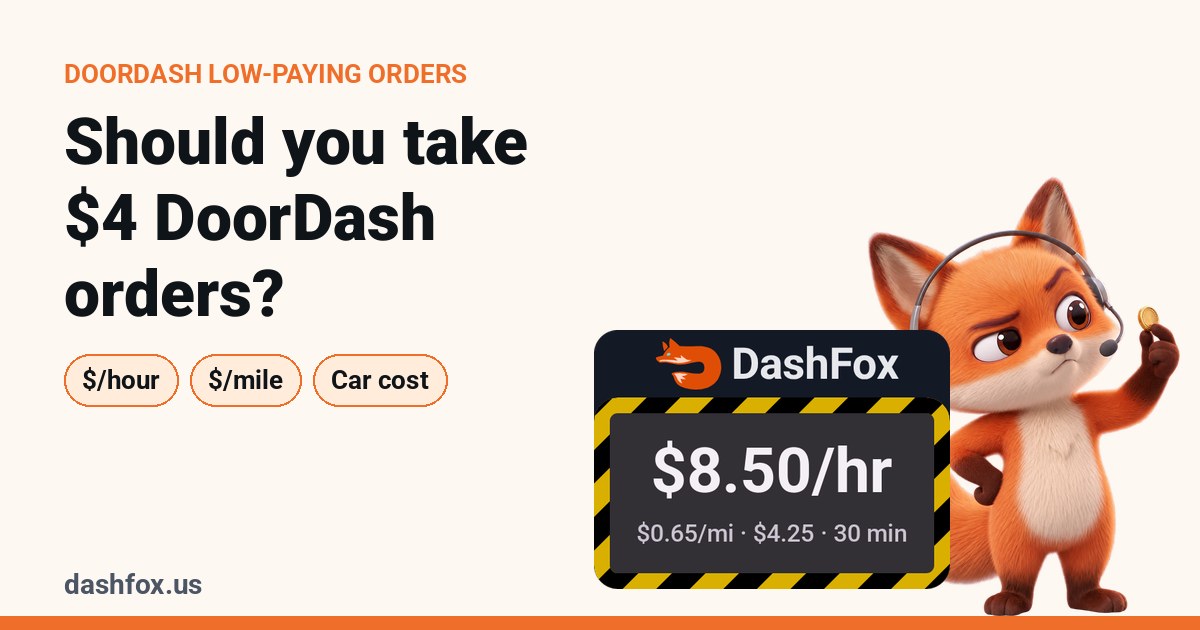
Should you take $4 DoorDash orders?
Two similar payouts, different time and mileage. Use your own vehicle budget, not a universal cutoff.
 Offer math
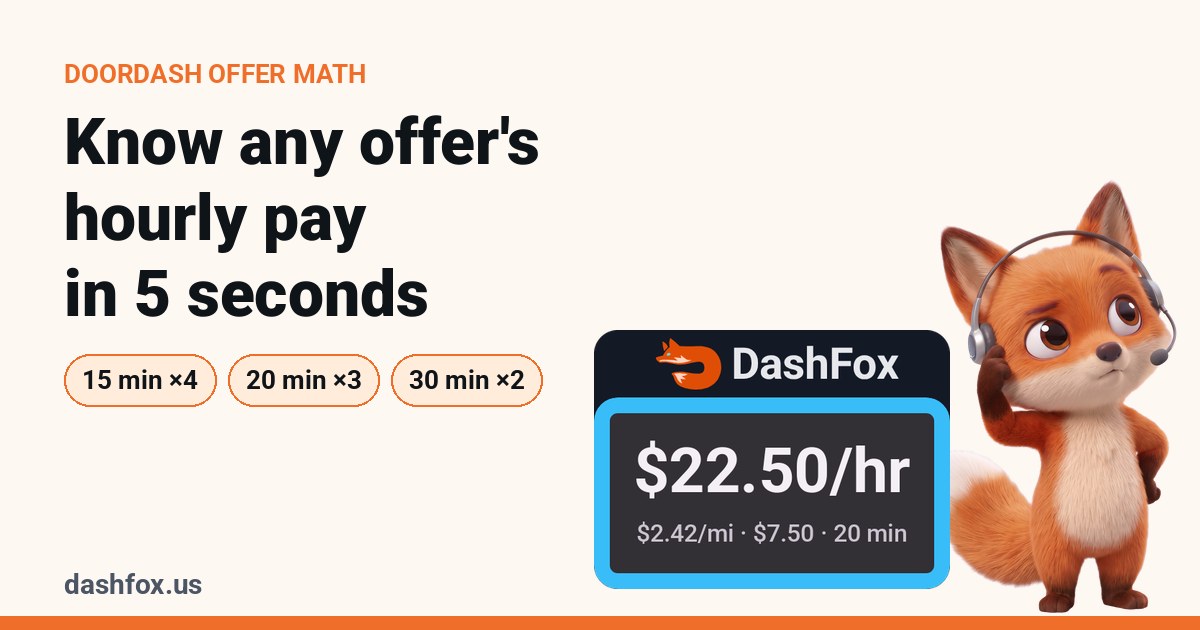
How to tell what a DoorDash offer pays per hour
Three quick mental-math tricks and a cheat sheet you can screenshot.
 On the job
DoorDash alcohol delivery: what actually happens, step by step
The ID scan, the checks, and what to do when you can't hand it over.
Sources
- DoorDash Help: Redesigned Accept Modal. The offer screen shows guaranteed pay (base pay plus customer tips; total earnings may be higher) and a "deliver by" time. Accessed November 5, 2026.
- Dasher Central: Dasher pay. Earn per Offer base pay depends on estimated time, distance and desirability, and you see the guaranteed minimum before you accept; Earn by Time pays a guaranteed rate for active time. Accessed November 5, 2026.
The $1-per-mile scenario and Examples 1–3 are made-up offers, rounded to the cent. The "From our own dash" offer is real: pay, miles and the DashFox hourly figure come from a dash we screen-recorded. None of it is typical earnings or a promise of what you'll make. Rates are gross, before gas, wear and taxes.