 DashFox
Subtract a realistic vehicle budget from the pay, then divide what's left by all the time the job takes. Include any unpaid driving you expect after the drop-off. Gas alone isn't the whole car budget.
In our made-up example, a $12 offer becomes $9 before tax after a $3 vehicle allowance. Over 34 minutes including the return drive, that's $15.88 an hour—not the $30/hour gross projection on the original offer.
There isn't one honest answer for every car or market. Use the steps below with your own records. The numbers here are Example data, not typical Dasher expenses, earnings or personal tax advice.
Start with your gas cost per mile
For a gasoline car, divide the price per gallon by the miles you get from a gallon. Use your own fuel receipts and measured driving rather than treating our example as today's gas price or your car's fuel economy.
Suppose you pay $3.60 a gallon and your car gets 30 miles per gallon.
Ten miles would use $1.20 of fuel at those assumptions. That answers the gas question—not the profit question.
If you drive electric, start with your charging cost and energy use instead. Either way, energy is only the first line in the budget.
Leave room for the car, not just the tank
The IRS's car-expense guidance lists gas, oil, repairs, tires, insurance, registration, licenses and depreciation or lease payments among actual vehicle expenses, with the business portion separated from personal use. [1] That's a useful reminder of what a fuel-only comparison leaves out, even though planning an offer and preparing a tax return are different jobs.
For your driving budget, build an allowance from your own maintenance history and ownership costs. Spread recurring costs over a realistic mileage period; allow for the car losing value, not just the bills due this week. Don't count the same expense twice.
Keep two questions separate: what extra cost does this trip add? and does the whole driving business pay its share of the car? Insurance or registration won't be charged again at each drop-off, but leaving them out of every shift won't make them disappear.
We use a fictional 18¢ per mile for non-fuel vehicle costs below. It is a chosen budgeting allowance, including an allocation for ownership costs—not a researched average, a quote for your car or an IRS rate. Added to 12¢ for fuel, it makes a 30¢-per-mile planning budget.
Follow one $12 offer all the way back
Imagine an offer showing $12 for 6 miles, with 24 minutes until delivery. DoorDash says the offer's guaranteed pay includes base pay and customer tips; final pay can be higher. [2] For this example, use the shown $12 without assuming an extra tip.
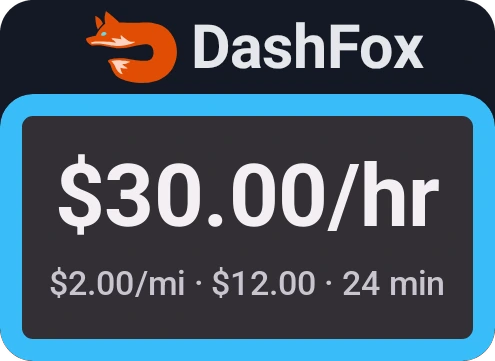
Now suppose the drop-off leaves you 4 unpaid miles and 10 minutes from where you plan to wait for the next offer. The job uses 10 miles and 34 minutes in your decision budget.
| Budget item | Amount |
|---|---|
| Shown pay | $12.00 |
| Fuel: 10 miles × 12¢ | −$1.20 |
| Other car allowance: 10 × 18¢ | −$1.80 |
| Planning remainder, before tax | $9.00 |
Divide that $9 by 34 minutes and multiply by 60: $15.88/hour before tax. It isn't measured profit: the vehicle costs and return trip are assumptions, and other business expenses aren't included.
Another six minutes waiting would make it 40 minutes for the same $9: $13.50/hour. If you actually receive your next suitable offer at the drop-off, the return assumption may be wrong in the other direction. Budget the route you reasonably expect, then check it against what happened.
Taxes are another calculation—not a flat fee per offer
The IRS tells independent-contractor gig workers to keep income and expense records, report their income and check whether estimated payments are needed. Its filing guidance uses Schedule C and Schedule SE alongside Form 1040. [3] Your car-cost planning remainder isn't automatically the taxable profit on those forms.
Don't treat the IRS mileage deduction as your actual cost per mile. The IRS describes standard mileage and actual expenses as two deduction methods, with eligibility conditions. [1] A deduction is not a dollar-for-dollar refund, and you shouldn't subtract a mileage allowance and then count the same gas and repairs again as though they were separate costs.
Our 2026 mileage guide covers the rate periods and records; our tax-document guide separates reporting thresholds from filing and estimated-payment rules. Use the applicable tax-year instructions or qualified help to plan your tax reserve. We haven't applied a pretend universal tax percentage to this $12 offer.
Turn the budget into your own offer floor
Try this backwards: desired pay for your time + vehicle allowance + trip-specific costs. Keep any tax reserve separate and be clear whether your time target is before or after tax.
Using only our example assumptions, an $18/hour before-tax time target over 34 minutes needs $10.20 for time. Add the $3 car allowance: $13.20 before any extra parking or tolls, other business costs or tax reserve. That's a personal planning threshold for those assumptions—not a recommendation that every Dasher should reject offers below $13.20.
At the end of a shift, compare final pay, all online time and total miles with your plan. A good individual offer projection doesn't guarantee a good whole-shift result. Change the assumptions when your records show longer waits, more unpaid miles or higher expenses.
Quick questions
Is DoorDash worth it after gas?
Work it out using your pay, all trip time and your own car budget. Fuel alone leaves out repairs, tires and ownership costs. Our fictional $12 trip leaves $9 before tax after a $3 vehicle allowance; it is an illustration, not a typical earnings claim.
How do I calculate gas cost per mile?
Divide dollars per gallon by miles per gallon. In the example, $3.60 ÷ 30 = $0.12 per mile. Use your own fuel price and observed fuel economy.
Should I subtract the IRS mileage rate from every offer?
Not as if it were a measurement of your car's costs. It is a tax-deduction method with eligibility rules. Use your own costs for planning and applicable-year IRS rules for your return. [1]
Does the DashFox bubble show net profit?
The offer illustration shows projected gross dollars per hour and per mile. It doesn't subtract your vehicle budget, taxes, extra waiting or unpaid return drive. Don't read its colour as a personal profit calculation.
Keep reading


Sources and example limits
- IRS Topic 510: Business use of car: actual-expense categories, business/personal allocation, standard-mileage eligibility, separate parking/tolls and recordkeeping. Checked November 12, 2026.
- DoorDash Redesigned Accept Modal: guaranteed pay includes base pay and customer tips; final pay can be higher; deliver-by information. Checked November 12, 2026.
- IRS Manage taxes for your gig work: income/expense records, reporting income, estimated payments and Schedule C/SE. Checked November 12, 2026.
All pay, fuel prices, fuel economy, time, distance and vehicle allowances are constructed Example data. The 18¢ non-fuel allowance is not a measured or recommended cost. Budgeting miles are not a determination that those miles are tax-deductible. No driver's profit, tax bill or savings has been calculated. General US information, not personal tax or accounting advice; local rules and individual circumstances may differ.