 DashFox
No. DoorDash's published reimbursement FAQ says it will not reimburse tolls, parking fees, parking tickets or traffic tickets. Those expenses are yours. [1]
Before accepting, budget the likely fees in both directions, a legal place to park and the time back. A possible business tax deduction is a separate question—not DoorDash paying you back.
The reimbursement form isn't for your parking bill
DoorDash's FAQ does describe reimbursement when you pay for a customer's order with your own card or cash, subject to its conditions. But it separately and explicitly excludes tolls, parking fees and tickets. An itemized food receipt and a garage receipt aren't the same reimbursement claim. [1]
Don't accept a marginal offer on the assumption that support will add the toll later. Also, don't assume a larger tip will rescue it: DoorDash says the offer's guaranteed amount already includes base pay and customer tips, although final earnings may be higher. [2]
Before accepting: check the expensive parts of the route
Build a quick mental checklist for the places you regularly deliver. Do the detailed rate research while parked, before the shift—not while driving or racing an offer timer.
- The crossing: check the toll operator's current rate for your vehicle, payment method and direction. Look at the return route too; don't assume the outbound charge tells you the whole cost.
- The alternative: compare the toll route with a permitted toll-free route using both extra minutes and miles. Saving a fee isn't automatically worth a long detour.
- The pickup and drop-off: identify a legal parking option. Check signs, time limits and any minimum garage charge; allow time to walk, find an entrance and get back to the car.
- The next move: will you reasonably look for another offer there, return to your usual area or finish the shift? Budget that likely drive without pretending the next paid order is guaranteed.
If you can't establish the fee or a workable legal stop, treat that as uncertainty in the offer—not as zero cost. Use the route and parking rules where you actually are; this guide doesn't grant a delivery-parking exemption.
A $14 offer, followed all the way back
Imagine an offer showing $14, 5 miles and 25 minutes until delivery. The gross rates look promising:
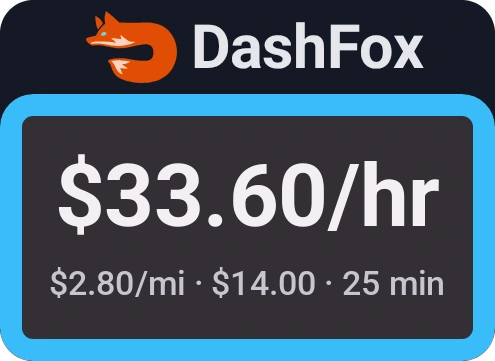
Suppose the whole outing incurs $3 in tolls and $2 in legal parking. After delivery, you expect an unpaid 5-mile, 15-minute return. The original 25-minute estimate already allows for pickup, parking and handoff in this example; total planned time is 40 minutes.
| Budget line | Amount |
|---|---|
| Shown offer pay | $14.00 |
| All tolls | −$3.00 |
| Parking fee | −$2.00 |
| Car allowance: 10 miles × 30¢ | −$3.00 |
| Planning remainder, before tax | $6.00 |
The 30¢ car allowance is entirely fictional, covering fuel and other vehicle costs; it isn't an IRS rate or a researched average. This remainder is not measured net profit: other business expenses and tax aren't included. Use your own vehicle budget instead.
The lesson isn't “reject every toll order.” It's judge the complete route. Different pay, fees or a useful next pickup near the drop-off could change the decision. Check your actual shift afterward rather than treating an estimate as a wage.
Parking trouble after you've accepted
Look for a legal alternative rather than turning an awkward pickup into a ticket. If access or instructions don't work, stop safely and use the in-app customer contact or support options to resolve the delivery. Asking for help isn't a promise of reimbursement.
For places you visit repeatedly, keep a short parking note: usable entrance, signed parking option, likely walk and actual fee. Build the real access time into later decisions. A saved minute isn't a good reason to leave the car somewhere unsafe or prohibited.
Can you deduct tolls and parking on your taxes?
Qualifying business-use parking fees and tolls are separately deductible under IRS Topic 510, whether you use standard mileage or actual expenses. That doesn't mean every charge during a dash qualifies, or that a deduction refunds the bill. Keep business use separate from personal use. [3]
Keep receipts or electronic statements, dates, amounts and a note of the business purpose. The IRS requires adequate records or sufficient supporting evidence. [3] Keep parking fees separate from penalties: Publication 463 says fines for traffic violations aren't deductible, and it identifies commuting-related parking as nondeductible. The edition currently opened is 2025; use the applicable tax-year instructions for your return. [4]
Budgeting the trip back is not a ruling that every return mile or toll is tax-deductible. Our mileage-records guide covers method and commuting boundaries. No personal tax saving is calculated here.
What about New York City bridge and tunnel deliveries?
Don't assume the same delivery routing rules apply everywhere. DoorDash's NYC help page says it does not offer deliveries requiring crossings over its listed bridges and tunnels. It describes an optional preference form for certain restaurant crossings if enabled in the future—not a toll-reimbursement promise. [5]
The offer above is an unnamed, fictional route, not a claim that DoorDash currently sends NYC orders across a particular bridge.
Quick questions
Does DoorDash reimburse bridge tolls?
Its published reimbursement FAQ says no to tolls. Budget the charge yourself; a support conversation isn't a guaranteed exception. [1]
Will DoorDash pay a parking ticket?
No. DoorDash's FAQ explicitly excludes parking and traffic tickets. Don't treat a ticket as a reimbursable delivery expense. [1]
Are parking fees included in the mileage deduction?
IRS Topic 510 says parking fees and tolls attributable to business use are separately deductible under either car-expense method. You still need qualifying business use and supporting records. A parking fine is not the same thing as a parking fee. [3] [4]
Keep reading
Sources and example limits
- DoorDash Dasher Reimbursement FAQs: order-payment conditions; explicit exclusion of tolls, parking fees and tickets. Checked November 13, 2026.
- DoorDash Redesigned Accept Modal: guaranteed pay includes base pay and customer tips; final earnings may be higher; deliver-by information. Checked November 13, 2026.
- IRS Topic 510: Business use of car: separate business-use parking/tolls, deduction methods and substantiation. Checked November 13, 2026.
- IRS Publication 463 (2025): parking fees and tolls, commuting parking and fines and collateral. Current opened edition is 2025, not a 2026 return manual. Checked November 13, 2026.
- DoorDash Bridges and Tunnels in New York City: listed-crossing delivery restriction and optional future preference form. Checked November 13, 2026.
General US information, not personal tax, legal or accounting advice. All offer amounts, tolls, parking charges, times, distances and vehicle allowances are constructed Example data, not local rates or typical earnings. No automatic toll detection, parking-cost calculation or net-profit feature is claimed for DashFox. Local rules, routes and applicable-year tax instructions control your situation.