 DashFox
A "per hour so far" number is what you've earned so far ÷ how long you've been dashing. With no new earnings, it falls as time passes; a posted payment can lift it sharply. That's payment timing, not a sudden change in your earning ability.
Use an offer's own estimated $/hour alongside its miles, costs and destination before you accept. Judge a completed shift by total earned ÷ total time online, before expenses and taxes.
One real dash, start to finish
This is a Sunday evening dash we screen-recorded in the St. Louis suburbs on February 1, 2026. DoorDash's own end-of-dash summary had the final answer:
Five of the six offers that night were accepted. That's one observed shift, not a typical earning rate. Looking at its running figure at different moments would have given you very different impressions of the same evening.
What the running number did
At minute 22 of the recording, $10.19 was banked and the screen showed $27.73/hr. Then came a long stretch of driving and waiting with no new payment. The number kept sliding:
Those rounded minute marks are an arithmetic check, not exact elapsed-second measurements. At recording minute 65 the screen read $9.40. At minute 66 a payment had landed and it read $25.79. It fell again before another payment lifted it to $26.31 at minute 81.

We got this wrong ourselves at first. When we first watched this recording, we read the jump from $13.72 to $25.22 as proof that declining bad offers pays off. It wasn't: only one offer was declined all night. The number was simply catching up after a payment.
Three numbers, three questions
| Number | Answers |
|---|---|
| Offer $/hour pay ÷ minutes × 60 | Should I take this one? |
| Running $/hour earned so far ÷ hours so far | What have I averaged so far? (Sensitive to payment timing.) |
| Shift $/hour total ÷ total time online | How did tonight actually go? |
The running number isn't wrong. It's an unfinished average. It can help you notice idle time, but a dip just before a delivery payment doesn't tell you what the completed shift will pay.
How to judge a shift fairly
- Wait for the end. Total earned ÷ total time online, including the time you spent waiting for offers. That's what your evening paid.
- Compare like with like. Same day of the week, same hours, same zone. A Tuesday lunch and a Friday dinner aren't the same job.
- Look beyond one shift. Repeated shift records give you a better picture than one lucky or unlucky night. Demand, tips and expenses can still vary.
- Count idle time honestly. DoorDash itself splits your dash into active time (on an order) and idle time (waiting for one). [1] Idle time is part of what your hour pays.
And for each offer, check its own rate before you tap Accept. Our offer calculator does it in a second, and this guide shows how to do it in your head.
Quick questions
How much do DoorDash drivers make per hour?
There isn't a single rate that describes every Dasher. DoorDash says pay varies by location and how you work. [2] Our recorded Sunday evening came out at $27.73 an hour before car costs and taxes, but one shift isn't an average for other drivers.
Why does my hourly keep dropping while I drive?
A running average divides the earnings recorded so far by the hours so far. If no new earnings post, the denominator grows while the numerator stays fixed. A payment can lift it sharply without changing the driving you've already done.
What's the difference between active time and dash time?
DoorDash calls the time you're on an order "active time" and the time waiting for offers "idle time"; together they make your dash time. [1]
Keep reading
 Pay modes
Earn by Time vs Earn per Offer
Put both modes on the same full-session clock before comparing gross earnings.
 Plan your dash
Best times to DoorDash: test your market
Use completed shifts to compare realistic lunch and dinner windows, not just a moving average.
 Ratings & rewards
Does your DoorDash acceptance rate matter?
No minimum, but it decides your Dasher Rewards perks. What a decline really costs.
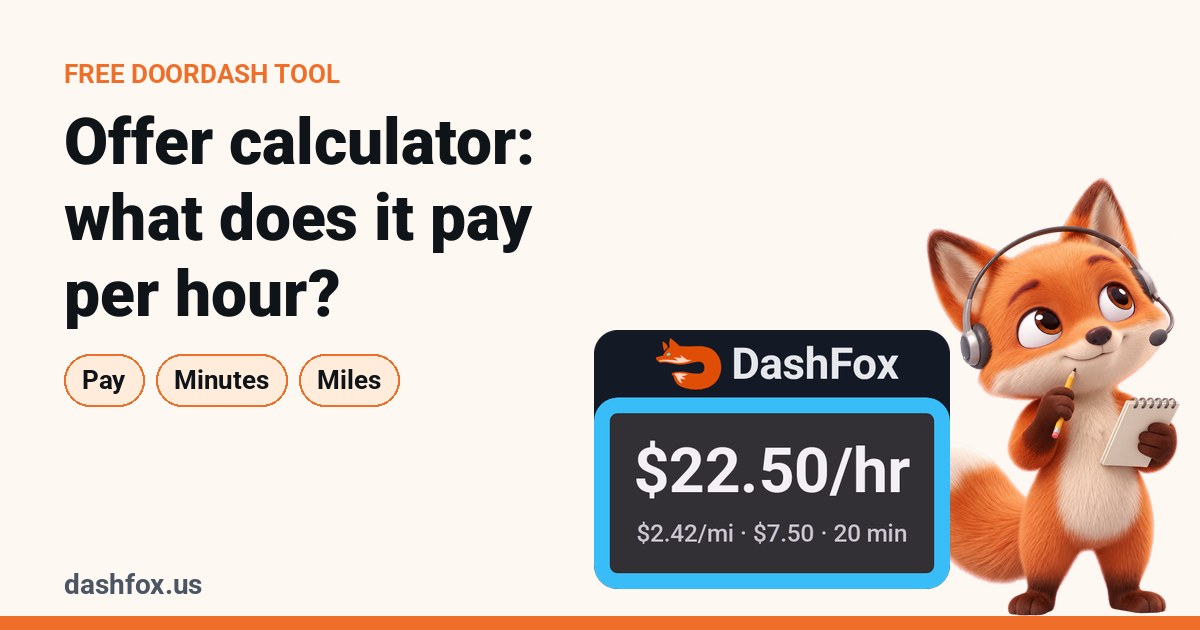 Free tool
DoorDash offer calculator
Pay, minutes and miles in; $/hour and $/mile out.
Sources
- DoorDash Help: Earn by Time mode. Definitions of active time, idle time and dash time. Checked October 29, 2026.
- Dasher Central: Dasher pay. Pay varies by location and how you work. Checked October 29, 2026.
The dash in this article is real: we screen-recorded it on February 1, 2026, in the St. Louis suburbs. The $56.39, 2 hr 2 min and 5-of-6 figures come from DoorDash's end-of-dash summary; the running figures were read off the recording once a minute. It's one shift, not typical earnings or a promise of what you'll make.